First published on myneurodivergentstory.blog
What “Clumsy” Taught Me: Living with Dyspraxia and Neurodiversity
For as long as I can remember, I’ve lived with the everyday realities of Living with Dyspraxia and Neurodiversity — the mix of coordination challenges, sensory quirks, and creative problem-solving that shapes how I move through the world.
I’ve always been clumsy — the person who drops mugs for no reason, bumps into furniture that’s been in the same place for months, and somehow manages to spill soup even when sitting perfectly still. Growing up, I was told to slow down, concentrate, or “be more careful.” Nobody realised that what looked like carelessness was really about coordination — or how my brain processes movement.
Well, not quite nobody.
In 1998, while I was at university, my parents told me they’d recognised traits of dyspraxia as far back as 1984. They used to play catch with me using a hard ball, hoping it would help improve my coordination. They meant well — and I’m grateful they noticed something was different — but like most parents at the time, they didn’t have the information to fully understand it. Awareness of dyspraxia began to grow in the 1980s through groups like the Dyspraxia Foundation UK, while the concept of neurodiversity emerged in the 1990s, rooted in the disability-rights and autistic self-advocacy movements.
Understanding Dyspraxia and Neurodiversity (DCD)
Dyspraxia — or Developmental Coordination Disorder (DCD) — affects the way my brain plans and controls movement. It’s not about intelligence or effort; it’s about wiring. I can picture an entire room layout in my mind yet still misjudge distance when I walk through it. I can visualise how to decorate a space but end up covered in paint before the job’s half done.
And somehow, fixed furniture — or the occasional door — always seems to have the audacity to jump out and hit me. Okay, it’s really me misjudging distance again, but the end result is usually another bruise to add to the collection!
At school, PE was a nightmare. I could never remember which foot to kick with or which direction to run. Team sports were chaos — I was always a beat behind, unsure where my body was supposed to go next. Shoelaces were an epic battle; I still tie them “the wrong way.”
My hands don’t always do what my brain asks them to, and fine-motor tasks — like fastening buttons, opening jars, or using makeup brushes — take patience and humour in equal measure. Even now, I can plan an entire project in my head but somehow drop the pen halfway through writing the first note.
Even now, there are everyday things I struggle with. Fastening a duvet cover is one of them — my husband can do it in minutes, while I spend ages wrestling with corners and misaligned buttons. He’s learned it’s faster (and safer) if he just does it himself!
I’m forever falling up the stairs, splashing things everywhere, and knocking into furniture that has the nerve to stay exactly where it’s always been. I like to think of it as the universe’s way of reminding me to slow down — though the new bruises tell a different story.
Still, I’ve learned to laugh at it. During a recent burnout and depression spell, I was too foggy to decide which mugs to declutter — until I dropped two of them. Problem solved. Not the method I’d recommend, but surprisingly effective!
Even when I learned about dyspraxia at university, it didn’t fully click. I remember thinking, so I’m just clumsy — I already knew that. It took years to understand that what I was dealing with wasn’t a lack of care or attention, but a completely different way of processing coordination and space.
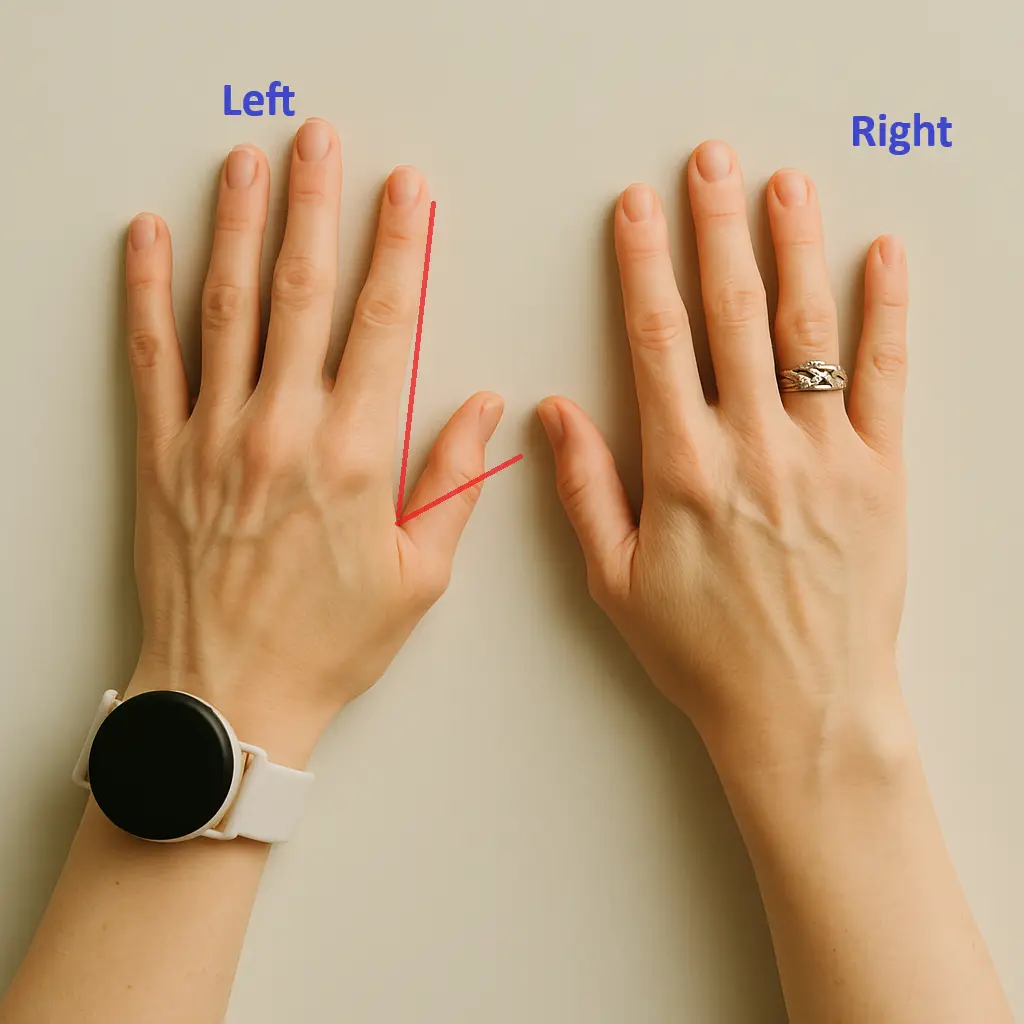
At secondary school, I was bullied for tying my shoelaces “like a four-year-old.” It stung, but now I know it was never about ability — just a difference in how my brain and body communicate. I still mix up left and right, though I have my trick: I hold my hands out, palms down — my left one makes a little “L.” It’s simple, but it works. Even so, I sometimes set the table the wrong way round or walk confidently in the wrong direction. Without Google Maps, there’s a good chance I’ll end up facing the wrong way — even in a building I’ve been in before!
Learning more about Living with Dyspraxia and Neurodiversity helped me realise that my struggles weren’t carelessness — they were part of how my brain works.
Workplace Challenges
At work, dyspraxia showed up in ways no one expected. When our process changed, we were suddenly required to photograph customer documents using webcams instead of scanners. Everyone else managed easily; I, however, couldn’t do it without shaking or dropping the camera out of frame. Trying to hold the webcam steady while pressing a laptop key felt like juggling and typing at the same time — not my strongest skill set!
The harder I tried, the worse it got. My hands shook, my confidence crumbled, and eventually I ended up in tears — embarrassed, frustrated, and convinced I was failing at something everyone else found effortless.
Once they gave me a document scanner with a stand, the problem disappeared overnight. Suddenly, my work became easier, the images were clearer, and everyone benefited. It was such a small change, but it made a huge difference — not just to me, but to accessibility for colleagues across the country.
That moment also led to something positive. Alongside my PTSD therapy and the growing recognition of my potential neurodiverse traits, I was referred to our occupational health team. They recommended workplace screening and support through Lexxic, who specialise in helping adults with neurodivergent conditions such as Dyspraxia and Neurodiversity, ADHD, and dyslexia.
That experience became a turning point in understanding how Living with Dyspraxia and Neurodiversity can affect even the smallest everyday tasks. With a formal screening from Lexxic and access to a neurodivergent coach from Genius Within, I finally had the opportunity to talk openly about how my brain works. For the first time, I began to see that the strategies I’d built over a lifetime weren’t failures or quirks — they were coping mechanisms that had helped me survive and succeed in a world not designed for me.
From there, my understanding began to grow. I started engaging in more conversations around inclusion and accessibility and discovered the value of Employee Resource Groups (ERGs) — including one focused on neurodiversity and peer support. Knowing I wasn’t alone, and that others were beginning to recognise similar patterns in themselves, was genuinely life-changing. It helped me see that Living with Dyspraxia and Neurodiversity isn’t just about personal challenges — it’s also about connection, shared learning, and community.
Seeing the World Through My Senses
Dyspraxia isn’t just about movement; it often overlaps with sensory-processing differences. My brain filters sights, sounds, and textures differently from most people’s — and sometimes it doesn’t filter them at all.
If a TV is on in the background, my attention locks onto it, even if it’s an irritating advert on repeat. I can’t tune it out. In crowds, voices merge into a wall of white noise, yet the quietest whisper — especially if it’s about me — cuts through like a knife. Living with Dyspraxia and Dyslexia, along with suspected ADHD and Autism, means the world can sometimes feel too loud, too bright, or too much.
Over the years, I’ve learned small ways to cope: noise-cancelling headphones when I need calm, tinted backgrounds to help my eyes process text, soft lighting, and quiet corners whenever I can find them. These tiny adjustments help create a sense of balance in a world that often feels overwhelming.
I also notice movement and rhythm more than faces. I often recognise people by how they walk or the sound of their footsteps rather than by facial features. It’s as if my brain catalogues patterns and motion instead of expressions. For years, I thought that meant I was bad with faces or names — maybe even unfriendly. Now I see it differently: it’s another way my Dyspraxia and Neurodiversity shape how I experience the world.
What “Clumsy” Has Taught Me
For me, Living with Dyspraxia and Neurodiversity — including Dyslexia, alongside suspected ADHD and Autism — means learning to embrace the way my brain and body connect: imperfect, but uniquely mine. It’s taught me patience and self-compassion, and helped me see that my so-called mistakes aren’t failures. They’re simply part of how my brain works — and often, part of what fuels my creativity.
Over time, I’ve realised that my body’s quirks aren’t barriers; they’re teachers. They’ve pushed me to find new ways of problem-solving — to adapt, to build tools and systems, and to approach challenges with curiosity rather than criticism. Those same skills now shape how I work, learn, and live every day.
More than anything, Living with Dyspraxia and Neurodiversity has deepened my empathy. I know what it feels like to struggle silently — to appear “fine” on the outside while juggling invisible challenges beneath the surface. It’s shown me that independence doesn’t mean doing everything perfectly or alone. Sometimes it means asking for the stand, the rail, or simply an extra minute — and knowing that doing so doesn’t make me less capable, just differently designed.
In Part 1 I shared how I first began to understand my neurodivergence. In Part 3 I explore how sensory processing shapes my daily life — and how learning to work with my senses, instead of against them, is helping me rediscover balance.
Leave a Reply